
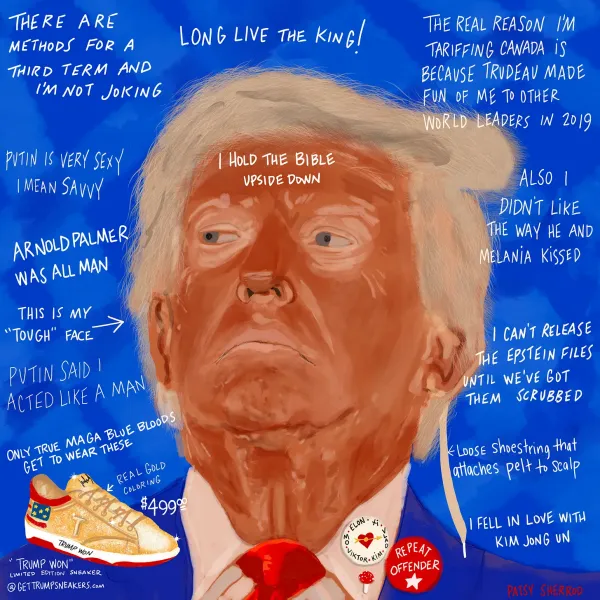
Public image from Michael Moore substack unable to identify creator
The latest 2026 report from global democracy watchdogs marks a moment that would have been difficult to imagine only a generation ago. According to the V-Dem Institute, the United States now ranks 51st out of 179 countries in measures of liberal democracy—a sharp fall from its previous position near the top tier, placing United States between Slovakia and Greece. While rankings alone do not tell the whole story, the trajectory is difficult to dismiss. This is not a statistical anomaly, but the visible outcome of long-developing institutional strain.
Democratic erosion in the United States has unfolded gradually over decades. It is reflected not only in the weakening of voting protections and the increasing politicization of the judiciary, but also in the steady degradation of norms surrounding information, accountability, and public discourse. A particularly telling dimension of this decline is the growing pressure placed on the free press and on freedom of expression—core pillars of any functioning democracy.
The United States has long maintained strong formal protections for speech through the First Amendment. Yet formal guarantees do not always translate into stable democratic practice. In recent years, journalists have faced escalating hostility, including verbal attacks from political leaders, restricted access to information, and an increasingly adversarial relationship between government and media institutions. The repeated characterization of mainstream outlets as “enemies of the people”—a phrase popularized during the presidency of Donald Trump—has contributed to a climate in which public trust in journalism has eroded significantly. According to Gallup, public trust in mass media has fallen to roughly one-third of Americans expressing a “great deal” or “fair amount” of confidence—near historic lows and sharply polarized along partisan lines. Similarly, according to the 2025 World Press Freedom Index by Reporters Without Borders (RSF), the United States has dropped to 57th place out of 180 countries, classified as having a "problematic" environment.
This pattern is not confined to rhetoric alone. During the George Floyd protests, multiple journalists were detained or targeted by law enforcement while covering demonstrations, raising concerns among organizations such as the Committee to Protect Journalists about press safety even in routine domestic reporting. Similar concerns emerged during student protests over the war in Gaza, where hundreds of demonstrators were arrested, in some cases amid reports of excessive force, highlighting broader tensions around freedom of expression and the right to protest. Earlier, the disclosures by Edward Snowden revealed the scale of government surveillance programs, prompting renewed debate about the balance between national security and civil liberties. Legal pressure on sources and whistleblowers, including the prosecution of Chelsea Manning, further underscored the risks faced by those who expose state actions.
More recent developments under the current administration reinforce these concerns in more direct and institutional ways. A controversial Pentagon policy enabling officials to revoke journalists’ credentials for seeking “unauthorized” information was ultimately blocked by a federal court, which found it risked viewpoint discrimination and undue restriction on access. At the same time, disruptions to the operations of Voice of America—which temporarily sidelined a large number of journalists before judicial intervention—raised alarms about political interference in publicly funded media.
Individual incidents have also drawn scrutiny: the detention of reporters covering immigration enforcement actions by ICE has prompted criticism from press freedom advocates, who question whether such actions risk blurring the line between law enforcement and retaliation against routine journalistic activity. More recently, Donald Trump and regulators signaled potential consequences for media outlets reporting critically on the war with Iran—including threats to revoke broadcast licenses or pursue journalists over leaked intelligence—highlighting a continuity of pressure that spans multiple administrations and underscores the vulnerability of press freedom in the United States
Beyond these incidents, broader policy shifts suggest a more permissive environment for scrutinizing journalists and their sources. Changes to Department of Justice guidelines governing subpoenas and leak investigations have reopened the possibility of more aggressive legal action involving reporters, raising concerns about a chilling effect on investigative journalism. At the same time, political efforts to reduce federal support for public broadcasting institutions, including NPR and PBS, highlight how financial pressure can intersect with broader conflicts over media independence. Taken together, these developments do not indicate the absence of press freedom, but they do point to a more contested and conditional environment than the United States has historically claimed. This perception is reflected in global assessments: Reporters Without Borders has consistently ranked the United States outside the top tier of its World Press Freedom Index in recent years, citing political polarization, declining trust, and increasing hostility toward journalists as contributing factors.
This rhetorical shift matters. Democracies rely not only on legal protections, but on shared norms that legitimize scrutiny and dissent. When the press is persistently delegitimized, its ability to function as a watchdog weakens—even if it remains formally free. In this sense, the erosion is subtle but consequential: it operates through perception, polarization, and the fragmentation of a shared informational reality.
Freedom of expression has also become increasingly contested in more diffuse ways. Across the political spectrum, there has been growing support for restricting speech perceived as harmful, misleading, or dangerous. While some of these concerns are rooted in legitimate issues—such as disinformation or incitement—the broader effect has been a more fragile consensus around the boundaries of acceptable expression. Social pressure, platform moderation, and political polarization have combined to produce an environment in which speech is more frequently contested, and sometimes self-censored, even in the absence of direct state repression.
These developments do not place the United States on par with overtly authoritarian systems, where dissent is criminalized outright. However, they do illustrate how democratic norms can erode without formal legal collapse. The weakening of trust in media, the politicization of truth, and the increasing hostility toward dissenting voices all contribute to a less resilient democratic culture.
The presidency of Donald Trump did not initiate these dynamics, but it significantly accelerated and amplified them. Norms that had previously constrained political rhetoric—particularly regarding the legitimacy of elections and the role of the press—were openly challenged. What had once been considered outside the bounds of acceptable discourse became normalized, revealing how dependent democratic stability is on informal guardrails as much as formal institutions.
For decades, scholars have treated the separation of powers in the United States as a reliable safeguard against democratic backsliding. Recent experience suggests this confidence was misplaced. Under Donald Trump, constitutional limits on executive authority—especially in foreign policy—proved weak in practice. Military actions, including those involving Iran and Venezuela, proceeded without meaningful congressional authorization, exposing how easily these constraints can be bypassed.
The more revealing failure, however, was institutional. Congress did not decisively defend its war powers; it hesitated, divided by partisanship and political calculation. In effect, it acquiesced. This underscores a central weakness: checks and balances are not self-enforcing. They depend on actors willing to use them.
The courts offered little resistance, continuing to avoid adjudicating such disputes. The result is not a formal breakdown of constitutional order, but a gradual hollowing out of its substance—where limits remain on paper, but lose force in practice.
Ironically, the United States has continued to position itself as a global defender of democratic values. For decades, American leaders have criticized authoritarian governments and promoted democratic governance abroad. This posture has shaped major foreign policy decisions, including the Iraq War under George W. Bush, which was framed in part as an effort to advance democracy internationally.
More recently, conflict with countries such as Iran continue to be framed through the language of confronting authoritarianism. Yet as democratic norms face strain within the United States itself, this rhetoric risks appearing increasingly inconsistent. The contrast between external advocacy and internal challenges becomes more difficult to reconcile.
This contradiction can be understood not only politically, but psychologically. The work of Carl Jung offers a useful lens through his concept of the “shadow”—the aspects of the self that individuals or groups refuse to acknowledge. These disowned traits are often projected outward, appearing most clearly in what is condemned in others.
Applied at the national level, this suggests that the United States’ focus on authoritarianism abroad may, in part, function as a form of displacement. By emphasizing the democratic failures of other nations, it becomes easier to avoid confronting internal weaknesses—whether in electoral systems, institutional norms, or the treatment of dissent and the press.
A complementary perspective comes from Sigmund Freud, whose theory of projection describes how individuals externalize uncomfortable truths to preserve a coherent self-image. In this light, moralizing rhetoric in foreign policy can serve not only strategic or ideological purposes, but also psychological ones—shielding national identity from contradiction.
The central issue, then, is not merely that the United States falls short of its democratic ideals. The deeper concern is a growing reluctance to acknowledge those shortcomings, particularly when they involve foundational elements like a free press and open expression. As criticism is redirected outward, opportunities for internal correction diminish.
If there is a path forward, it requires confronting these dynamics directly. This means not only strengthening electoral systems and institutional checks but also reaffirming the cultural and normative foundations of democracy: respect for a free and independent press, tolerance for dissent, and a shared commitment to truth as a public good.
The drop in global rankings is not a matter of bias or a technicality—it is a clear reflection of deeper, systemic weaknesses. Like a mirror, it does not lie; it exposes the cracks in the foundations of American democracy.
The question is no longer whether democracy in the United States is under strain—the evidence is unmistakable. The real test is whether the nation will confront these vulnerabilities honestly or continue projecting its concerns abroad while deferring the difficult work of self-correction. One point, however, is clear: democracy is not self-sustaining; it depends on public vigilance, accountability, and civic courage. Left solely to institutions and bureaucratic inertia, it risks gradual erosion.
Yet under the presidency of Donald Trump, these principles were significantly undermined at a pace many observers consider unprecedented. The longer the nation ignores its own reflection, the deeper that erosion becomes—and the more difficult it will be to reclaim the democratic ideals it has long claimed to champion. the more difficult it will be to reclaim the democratic ideals it has long claimed to champion.